I've been in another world for a long time.


There's a lot of things I can stand. And a couple things I can't.

I'm only too aware of my faults. Boy, am I.

Some of them I can change, and I'm working on those.

Some of them I can't change, and I accept those as part of who I am, and make peace with myself, secure in the knowledge that I have other qualities that compensate.

(Some of them I can change, but I lack the courage or strength or willpower or desire or motivation to do anything about it. So I keep them around as a ready excuse, in case anyone ever asks; I can point to them and say, "See, that's why, and I'll do something about them someday, and then everything will be great." They're my crutch.)

(That's another post for another day.)

-----------------------------------

Here's the thing: I know I have strengths, too. I'm good at lots of things. And I'm not just talking about skills like playing the piano or quoting lines from movies (or writing obscure cathartic late-night missives that no one understands but me). I'm talking about qualities, traits of personality, things about Me that are Mine, that are Good.

There have been times in my life where I was more sure of that, and times when I was less sure. But by now I'm pretty confident in the qualities I have. And in the shadows I don't have.

So when someone takes those very qualities -- things that I've spent a lifetime cultivating, things that I use to buoy myself up when I remember all those faults, things that I remember when I get two flat tires in a week and another late night at the office and another meeting in the morning that I'm not getting paid for and a cold that won't go away -- when someone, someone I care about, takes those qualities and accuses me of not having them, of being the thing I always hated and tried with all my heart not to be, and then runs away, shuts down, prevents me from doing anything to prove that someone wrong, to show that I'm not That Guy...

I can't take that.

-----------------------------------

And yeah, I know it's not really my fault (and I can't help but think of Matt Damon bawling his eyes out on Robin Williams' shoulder when I say that, even though the comparison is silly and the difference in degrees is gargantuan). But it sure feels like it is. It's all my fault. When the chips were down and someone needed me most and I had the perfect opportunity to utilize 26 years' worth of compassion and empathy and love, to utilize Myself in the way that only I can... I blew it.

And I think, maybe I never had it in the first place. And that absolutely kills me.


-----------------------------------


 I don't truly believe what I just wrote there.

But tonight I do.

I don't know what you just said because I was thinking about Batman.


I was just leaving the bathroom for the evening, having taken my customary seat on the toilet (even though I didn't need to actually take the seated position but I wanted to read a few pages in the David Sedaris book that currently rests on the tank) when I happened to look myself dead in the eye.

I saw Age there.

It was no more than a glance, a fleeting passing wisp of a presence that I don't know if I've ever felt before.

Like most people, I don't feel old. More to the point, I don't feel like an adult. I feel like I got to about 19 years old and then went to South Africa and skipped a couple birthdays while I was there and when I got back I forgot how to remember the years I was gone and so I'm stuck in this anomaly in the space-time continuum where my hair gets grayer and I get fatter but my Me-ness never changes. It's like the inverse of Groundhog Day -- everything around me is altering, shaping, progressing, decaying. Somehow my body left my soul behind -- just after high school, I think.

Except when I caught that glimpse of Age in my eye in the bathroom mirror at 3:30 a.m., I suddenly saw and sensed and felt every one of my 26 years.

I guess I am an adult. It must've happened when I wasn't looking.

the worth of a game.


I wrote this on the blog I write for at www.deseretnews.com. It's about the value of video games (if they have any [I think they do]). You should go read it.

I don't make plans.


It's hard to tell.

I've got all this... something. Love, I guess. Compassion. Empathy. Charity. Something.

I'm like anyone else; I've been fed (gorged, really) on modern romantic comedies and Disney princesses and classics of unrequited-ness and fantasies that transcend time and space and dimension and (like Rob Fleming/Gordon said) thousands of songs about broken hearts and rejection and pain and misery and loss. I don't think it has made me miserable, though. It's just made me confused.

It's not that I expect fantasy. I don't. I want reality.

I just can't tell when reality is there. If it's there. If it ever can be.

Everyone else seems to know when it's there. They don't just believe in it; they know. They can tell their eros from their philia, their agape from their storge. They have experience -- real-life, this-actually-happened proof. I don't. I've been close. But not close enough.

I can't tell if I'm living an unwritten life or just writing it myself, but badly. Or maybe the writing is there, but the performance is off, the emphasis all wrong, the metaphor over my head, and I stumble through the reading, uncomprehending, unfeeling, dull.

Because I know not what I do when all this... something, that I have, comes out. There are reasons there, obviously, somewhere inside my psyche, if you'd care to poke around in it (and I'm not sure why you'd care to, but some days I wish I knew how). But there's one reason that should be there. I'm not sure I can identify it.

When you're already willing to do anything for anyone, just because they asked, how can you tell when the asking is more important than the doing?

When everyone means the world to you, how can you tell when someone means the sun and moon and stars?

I don't know.

Yet.

merry.


on sports, part two.


FACT: being a sports fan is one of the easiest ways to establish an immediate connection with someone you've never met before. That can either be a Good Thing or Bad Thing, depending on the nature of the connection.

Case in point: I'm sitting on the couch, watching tonight's dismal Utah Jazz performance in Atlanta. Comes a knock at the door -- it's a friend of my roommate's. I've exchanged maybe two sentences with him in my life. He enters, strolls past the television.

"Who's winning?"

"The Jazz are getting killed."

"YES!" He triumphantly clenches both fists.

I raise an eyebrow. "What, are you from Atlanta or something?"

He grins and ignores my question, walking down the hall.

"Ah, so you just hate the Jazz."

Laughter. Still not a word, just the grin as he looks back over his shoulder at me. Then he's gone.

-----------------------------------

This part, I don't get. I don't have it in me. I can't muster the requisite rage, the ignorance, the belligerence, whatever it is.

And that's not an indictment or judgment on those that can and do, by the way. I've known plenty of completely rational, intelligent, sensitive men (and women) who, when faced with playing or cheering against a rival, become... well, not really any of those things.

And maybe that's the point for them, that channeling that kind of aggression and passion, venting it in a (mostly) harmless fashion, allows for a more peaceable and kindly existence outside of that sphere. Much better, you would think, to hate a rival sports team than, say, another race or religion or gender or profession or person of any kind. 

But I can't do it.

-----------------------------------

Oh, I feel outraged and frustrated and angry when things are going badly. But it's because of the game, not the opponents, or the opposing fans, or anything else.

I think this is, again, the influence of my father, in large part. He taught me to be a student of the games, to appreciate fine play no matter where it occurs, or by whose hand. And I do, and though I have my favorite teams, I will always enjoy a singular performance by an athlete at the top of his game.

It's also because I've mellowed as I've gotten older (all of 26 years, as of Thursday), and my personality was never predisposed to that sort of thing no matter my age. I guess I don't get the allure of being deliberately obnoxious in order to provoke a reaction. (Okay, I do get it, I just don't want it.)

-----------------------------------

It's a combination of all those things, added to my current profession as a journalist. When you cover, for example, a BYU football game, you sit in the press box (which is its own little microcosm of strange that I'll have to write about sometime). And in the press box, there is no cheering. Of any kind. This is to maintain, even as a college student, the (mostly fictional) idea that the journalists are impartial and covering both sides with an equally analytical and discerning eye.

(I have since come to find out that different press boxes in different locations have vastly different standards regarding this principle, a fact that simultaneously amuses and annoys me.)

-----------------------------------

Here's another factor related to my profession: one of my current duties is to periodically monitor and moderate the user comments on each website article. There are a variety of ways that newspapers handle this feature, but because of the responsibility my employers have to their owners and their audience, we rule things pretty tightly.

But even so, the amount of rubbish that gets through is highly noxious stuff, and has contributed in large part to an alteration in the way I watch sports. It's the heady combination of the anonymity of the Internet, the socially-acceptable outlet of sports hatred, and a healthy dose of insecurity -- a recipe for remarks so irrational, so spiteful and mean, and (probably) so unlike the actual personalities of the people involved that it would be laughable if it weren't so horrifying.

Whatever the cathartic benefits of fandom, that cost is getting to be far too high for my liking.

-----------------------------------

Last month I attended the yearly rivalry game at LaVell Edwards Stadium, and for the first time in four years I was there in an unofficial capacity. The ticket was a gracious gift from my uncle, who also brought two of his sons. We sat in the west stands, away from most of the boisterous students and among the more taciturn, older crowd. (Note: I say "more taciturn," not "entirely taciturn," because some of the old men in the west stands are as irascible as any young hothead.)

I expected to yell. I expected to relish the opportunity to be free from the oppression of the press box and the pressure of deadlines and note-taking. I expected to cheer and clap and exult and despair and be a fan again.

I didn't.

-----------------------------------

I couldn't, somehow, at least not outwardly. I ended up watching most of the game silently, pumping a fist at a big play, sharing observations with my uncle, taking cell phone pictures and tweeting. I of course thrust my arms into the air and punched the sky in victory as the winning touchdown was scored, but that was about as exuberant as I got.

For all the reasons and explanations discussed above, my fanship has changed. But I think it's been for the better. While my outward observances have diminished, my inward love for the game has never been stronger or more personal. I think I like the fact that I appreciate sports in my own unique way. There is room yet for the passionate but reasonable sports fan, and I'm glad.

-----------------------------------

The problem is, not everyone sees it that way. Too often, to be considered a "fan" you have to conform to a set of stereotypes and shared assumptions that just don't fit. (Then again, this sort of thing has been a hallmark of every restricted societal group since civilization began, and it's part of why the pantomime hatred of the sports fan is dangerously congruent to the real thing.)

I headed home to my Salt Lake City apartment after the game, and as I traversed I-15 amid a sea of blue and red bumper stickers and car flags and barely restrained fervor and antagonism, I couldn't help but turn on the post-game radio shows. I flipped back and forth between the flagship stations of the two schools, listening to the different viewpoints and weighing them against each other -- I seriously can't turn off my even-handed journalist side any more, not even a little -- until I heard the discussion of a certain player's comments in a post-game interview.

I listened as he spelled out his avowed hatred for his opponents, an all-encompassing pathos that spared no aspect or individual associated therewith. Of course, my first thought was, "There's a week's worth of extra work for us at the office." But then I considered the ramifications of these statements, not for the player in question, but for the teams, schools, and each person who associates himself with them.

-----------------------------------


See, too often in sports fandom, there is no middle ground. There's no place for the moderate, the bipartisan, the non-absolutist. You're with us or you're against us. Friend or foe. That's the nature of competition. But it isn't my nature. Nor, I suspect, is it the nature of many of the people on either side of a rivalry.

I guess that's life, though. And like a true sports underdog, I'm going to keep fighting for my own little scrap of fanhood the way I see fit. Because I'm still far too passionate about, and derive far too much enjoyment from, the consumption of sport to ever give it up. It is mine, no matter what anyone else thinks.

jazz, the utah kind.


If you're interested, I'll be writing more frequently here, about young men who try to make a leather ball go into a metal circle. A sampling from a recap of tonight's game:

The fourth quarter was probably the most entertaining part of the game for Jazz fans, as a lineup of Eric Maynor, Wesley Matthews, Ronnie Price, Andrei Kirilenko and Kyrylo Fesenko looked like the only players with "Utah" on their chests who gave a crap.

Of course, by then, the conversation in the Game Thread had turned away from the basketball game and onto such thrilling topics as "Peanuts: Not Actually Nuts At All" and "I Have Too Many Vowels On My Scrabble Rack."

Honestly, there may be other insights to glean from this game, but I don't have the energy to try right now. I'm serious. I had observations in the first half. At least I think I did. I mean, there they are in the Game Thread, with my name beneath them and everything, but the rest of the game was so boringly depressingly terrible that I think it deprived me of my ability to remember things I actually said.

So, you know, there's that.

on sports, part one.


It's kind of odd, when you think about it.

Why do I care so much about the young men running around the court or field, chasing after a spherical object of one kind or another, attempting to score as many goalunitbaskets as possible?

The fact remains that I do care, and probably always will, though recent events have shown me that the nature of that caring may change. And I think I'm okay with that.

-----------------------------------

Sports were a mostly solitary activity for me as a child. (Despite growing up in a family of five children, I seemed to be on my own most of the time, whether voluntarily, or to avoid being given chores, or because I was just that absorbed by my own imagination.) I know my father, an excellent natural athlete, had much to do with my interest in football and basketball, but it seemed that even from an early age I had a personal and abiding passion for both playing and watching games of all kinds.

When I arrived home from school I would immediately retrieve whichever filthy basketball had the most air remaining inside it from the blue storage containers stowed beneath my father's workbench in the garage, and I would shoot, sometimes for hours on end. I would practice moves against invisible opponents, fictional and professional alike. (I took a particular, strange enjoyment in defeating video game characters in these self-conceived battles. Somehow beating Imaginary Link was more satisfying than beating Imaginary John Stockton, and I'm not sure why.) I would stand at the chip in the cement driveway that just happened to be almost the precise distance for free-throw shooting, and fire off fifty straight, running to retrieve misses and delighting when the perfect spin on the ball and the snap of the net returned the ball to me without forcing me to move my feet. I would shoot and dribble and spin and jump until the nubs on the ball were worn smooth from a million caroms and a billion bounces.

-----------------------------------

Sports are a horrible thing to dream about, because it becomes readily apparent at a very early age that those dreams will never be reality. Even at 25, it's possible to fantasize about being a best-selling novelist, or a famous musician, or any number of things that can bring fame and glory. But I knew before I hit puberty that I would never be a professional athlete. (And if my 12-year-old self could have seen my 25-year-old self back then, he'd probably be simultaneously amused and horrified that he'd ever dreamed about it in the first place.) That's a harsh sort of disillusionment to face.

Maybe that's why I dedicated myself instead to being a fan. I have often commented to peers that, were I to never use my sports knowledge to somehow provide for myself financially, there is no way I could justify the amount of time and resources I have spent as a spectator.

But that's not really true. I don't regret a single dime I've ever spent on a ticket to a sporting event, regardless of the outcome. And while I am now a journalist, and do indeed employ my comically-vast knowledge of sports in my daily work, that's still not the reason I remain a committed fan.

What that reason is, I don't know that I'll ever be fully able to identify.

-----------------------------------

I can make a couple of guesses. Solitary childhood aside, sports is still the best way I can connect with my father, and when we combine his first-hand knowledge of how games are played with my memory for facts and facility for strategic identification, we really make an unbeatable commentary team. (If I had a nickel for each time one of us made an astute observation five seconds before the announcers on television made the exact same comment, I would be a very rich man.) To deny his influence on my continued fandom would be silly. But nowadays, when I see him at most once a week, it's hardly the main cause.

Beyond that, I think it is easy for sports to become a source of catharsis for fans. A place where yelling at the top of your lungs, expressing joy and outrage and despair and hope and satisfaction all at once, is not only allowed but encouraged, is priceless in an existence too often bogged down by ennui and routine and drudgery.

Being a sports fan goes even further, though, and this is one of the hardest things to explain about the value of being one.

-----------------------------------

In Nick Hornby's excellent Fever Pitch, the memoir about his obsession with English soccer team Arsenal (which was later adapted for American audiences by the Farrelly brothers and became that absolutely execrable Red Sox-centric Jimmy Fallon/Drew Barrymore chick flick), he explains that being a fan gives one a sense of belonging, an instant kinship with thousands of complete strangers, not to mention the athletes themselves. To be a fan, he explains, is not to share in some sort of vicarious victory, but to actually participate in the battle itself -- not by running up and down a soccer pitch, but by making a conscious decision to support, to follow, to read, to watch, to learn, and to love. It takes a unique kind of commitment, one that bears as its fruit a joy that is qualitatively different from that of the athletes who determine it, yet no less valid or real or joyous.

Perhaps it is even more so. Who is happier, the athlete who gives of himself physically over the course of a season to help deliver a championship to a team long bereft of one, or the fan, who has sat through countless unsuccessful seasons, braving inclement weather and inclement fortune, only to be rewarded with that moment of victory? To whom does the title of "champion" mean more?

-----------------------------------

I'm romanticizing the notion here, but I think that's kind of my point. Sports can and should be romanticized, even in the age of multi-million-dollar contracts and shoe sponsorships and Gatorade and bling and body ink. At least, I'll never feel guilty for being romantic about them.

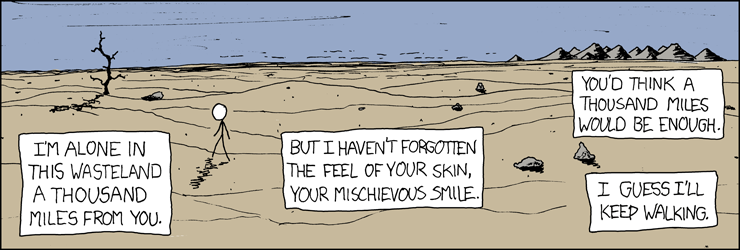
you make forgetting look so easy.


from xkcd.

east dillon.


I wrote about this once before, a long time ago. But I need to write about it again. There is no better television show currently on the air than Friday Night Lights. And chances are, you've either never heard of it, or you dismissed it because it's "about football."

It's not about football. It's about drama, relationships, family, high school, marriage, and small-town America, wrapped up in a football package. It's a double shot of life with a football chaser.

Friday Night Lights is filmed in an almost documentary style, all hand-held cameras and tight frame shots and unconventional angles, which combined with the superb acting leads to the feeling that these are real people, with real joys and sorrows, and we're all being granted a beautiful opportunity to share in everything. And Coach Eric Taylor, his wife Tami, and his daughter Julie are hands-down the most genuine family in television history.

It's like a reality TV show if reality TV didn't suck.


And this season (the show's fourth, which is currently airing exclusively on DirecTV but will come to NBC next year) may be the best of all, as it puts Coach Taylor in an impossible situation (reviving the dirt-poor crosstown high school's football team with a bunch of scrubs and no funding) and still manages to make his failures almost absurdly heroic.


(Also prominent in that scene: the Sufjan Stevens version of "Come Thou Fount Of Every Blessing," a perfect example of FNL's impeccable taste in soundtrack. Most incidental music in the series is provided by West Texas ambient-rock band Explosions In The Sky, a group I can't recommend highly enough.)

Look: if you like football, you need to watch this show. If you couldn't care less about football, you need to watch this show. (I privately suspect that more than a couple of girls I have dated enjoyed watching FNL with me more than they enjoyed, you know, me.)

If you are at all interested in good television, you need to watch this show.

I will buy you Season 1 myself if I have to.

Because I know you'll buy the rest on your own.

modern warfare 2.


Sometimes I have thoughts about video games, and I write those thoughts down, and the newspaper I work for puts them on their Web site. You can read them here.

valerie.


I used to work at Comedy Sportz.

It sounds more impressive than it is. I say it that way because I want it to sound impressive. I want it to imply things that aren't necessarily apparent. (Or, like, you know, true. Like that I'm funny and witty and outgoing and can hold the attention of a crowd like a real actor. I'm not, and I can't, at least not all the time. But it's a nifty little trick of self-delusion.)

"Work" is hardly what it could be called. What it was, was that I fell into an association with a few of the improv folks through my brother's friend Clark, who was part of the troupe. They needed keyboard players. Not super talented, complicated, professional musicians, but just someone who could hold down simple chords and follow the actors as they invented melody and lyrics. I happened to play the keyboard. Things seemed to work out.

It gave me something to do on my weekends while I was still in high school and early in college (back when I fretted about having things to do on the weekends, instead of what I do now, which is basically nothing, so I guess not much has changed, except that I don't fret about it now).

They paid me a paltry $20 for every night I played, so it was hardly a "job." I'd have done it for free. It made me feel like part of something that was undeniably cool, even if my personal coolness level was up for debate.

One thing it didn't do for me, however, was get me introduced to any girls. Too much of a Provo date scene, the Comedy Sportz. Plus, nothing's sexier than a funny guy. The guy who sat in the booth at the back and played Ben Folds off the top of his head in between scenes? Not so much.

The story I'm about to tell is the one exception.

-----------------------------------

The club is pretty full tonight. Full of young lovers and less young lovers, of awkward freshmen on first dates and established couples who sit with relaxed postures and embrace after each laugh with an intimacy that makes me wince in jealousy and frustration.

I'm flying solo again, as I usually do when I play. I'm allowed a cast comp every so often, and sometimes I manage to convince a girl or a friend (never a girlfriend) to tag along, the prospect of free comedy and a minimum of required interaction with me just tantalizing enough to make it worth the effort. It always ends up awkward, though; the friend-person has to sit by themselves as I do my music business, and then I have to bid them farewell as they leave before the late show begins, to get on with the real activities they have planned for their Friday or Saturday night, the stuff they actually wanted to do in the first place.

So yeah, most nights are like this one, with me sitting on a woefully unstable office chair in the raised sound booth at the back of the theater, the Yamaha keyboard with the worn buttons in front of me, the sound guy on my left blaring out catchy, inoffensive pop mixes through the less-than-ideal speaker system.

-----------------------------------

It's frustrating, the being alone, because despite the self-deprecation I'm feeling way more confident than usual. It's late summer, and I'm preparing for my freshman year at BYU, and the thought of starting a completely new experience, especially one where no one in my classes will know my name or my power-nerd background or my ridiculously stunted romantic encounters, is exhilarating. I've even developed something of a new look for myself: product-filled hair that I would later come to associate with J.D. from Scrubs; my favorite white and green ringer T-shirt with the hand-drawn logo on it; wraparound shades with yellow lenses that make me look somewhere between Bono and a downhill skier but that I somehow manage to pull off, even indoors. They're ludicrous affectations, all of them, but they're MY affectations, and the fact that I enjoy them imbues me with an energy I rarely find in myself, and I know I need to roll with it for as long as I can.

So with all this mojo working, I have no one to use it on, and this dampens my mood a little. But I know that soon the jokes will start flying, and I'll have opportunities to drop in bits of melody from whatever pop culture reference is made on stage (a feat that never fails to delight the actors in its off-the-cuff, by-ear alacrity), so I won't have too long to feel morose.

-----------------------------------

Near the end of the first half of the show, we catch each other looking.

She's with a group of girls, a last hurrah between friends or roommates before separating for the summer, perhaps. It's dark in the theater, but I can see her shoulder-length black hair tucked loosely behind her ears, and she has the kind of large dark eyes and open face that hold my attention.

For a second too long, in fact. Because she glances up towards the sound booth -- she's sitting in just the perfect part of the theater for this -- and our eyes meet for that tiniest sliver of time where you suddenly realize you've been staring, and she knows you've been staring, you both know, and no amount of shuffling or pushing buttons or looking busy can hide it.

Before I jerk my eyes away, I see a ghost of a smile play across her lips and a spark of mischief in her eyes.

-----------------------------------

During the intermission, I argue with myself. I've got nothing better to do for the ten-minute duration, and she already knows I was looking, and she doesn't seem too bothered by it. On the other hand, I think, she's got all her girlfriends with her, doesn't want to be hit on in front of them. On the other hand, she really is cute, and you never take opportunities like this. On the other hand, the reason you never take opportunities like this is because they always blow up in your face. On the other hand...

I pull this Tevye act through the whole intermission, and before I know it, the lights are dimming again and it's time to be funny.

-----------------------------------

Curt is running the show tonight as the "ref," and he's always careful to thank the door staff and the sound and keyboard guys as he's starting things back up. He and I also have a standing joke, stemming from my ability to play by ear, which he sometimes uses as a warm-up to get the audience laughing again. And Thespis be praised, he's using it tonight. Perfect.

"You know, Layton is such an amazing keyboard player, he actually knows every song ever written. True story."

The audience chuckles.

"In fact, you can even test him on it. Seriously, somebody just yell out the name of a song. Any piece of music. Something really obscure."

Several things are yelled out, the clearest of which is "the theme music from The Exorcist." (Side note: I have not seen The Exorcist.)

"There we go... Layton, do you know the theme music from The Exorcist?"

I look straight at the stage, my face expressionless. "Yep."

A beat.

"... See, told ya he knew it."

Laughter and applause. I sneak a glance at the girl. She's grinning at me. I grin back sheepishly. Bingo.

-----------------------------------

For the rest of the show, I can barely keep my mind on my cues. I'm feverishly trying to come up with something to say to her, the right way to approach her, how to smoothly acknowledge the rest of the party she's with while focusing on her. New look and confidence notwithstanding, this is never something I've been good at, and I'm both thrilled and terrified.

As the show ends, the actors run out onto the street to greet the audience as they exit. She's across the audience from me, so I have to wait for her and everyone else to get out the door before I can leave the booth. She wiggles a wave in my direction as she walks out. Ignoring my instinct to charge through the lingering crowd like a rampaging rhinoceros, I play it cool. I can catch her out on the street when the crowd thins.

I make it out the door and lean against the wall of the theater, scanning the crowd. She and her friends shake the actors' hands, then stand talking and laughing to each other for a moment. It's now or never.

-----------------------------------

I freeze.

Completely.

-----------------------------------

I don't even know what happened, but I couldn't move. I think I tried -- I must have tried -- several times, but I felt like I was sleep paralyzed, like the dreams I have when I'm trying to play basketball and I suddenly can't dribble at all, can't even bounce the ball once, and I jolt awake and realize I've been trying and failing to move my arms and legs. This is like that. At least I think it is. I seriously can't remember.

By the time I come to, she and her friends are a ways down Center Street, getting into a black SUV. Unless I want to run down the sidewalk after her, it's not happening. And I can't believe that I've managed to screw this up so badly.

The black SUV pulls out, flips a U-turn, and motors east on Center. I wave as it passes, one last desultory effort at saving some face for myself. It doesn't help.

Until the SUV flips another U-turn. And pulls over. And the door opens. And suddenly there she is, walking towards me.

-----------------------------------

She's wearing a simple light yellow top and shapely jeans that hug her petite frame in just the right way. She's grinning at me again. For heaven's sake, man, stop staring! You can do this!

My mouth opens, speaks. They may or may not have actually been my words -- I can't tell, because I can't remember thinking them. But it is my voice, and it's even got a note of guilty, playful confidence in there.

"You know, I was just sitting here kicking myself for not coming over and talking to you."

"I know." Still smiling. I have to will myself not to grin too widely back.

"I'm Layton."

"Valerie."

We shake hands.

"How'd you like the show? First time?"

"Yeah, I loved it, never laughed so hard in my life. So, did you really know that song?"

"Um. Maybe." Now I can't help but grin. "Okay, I had no idea. Don't tell anyone or I'll get fired."

She laughs, and my mind goes blank again. I don't even remember how I pulled it off, but somehow I came away with her phone number, and the advice that she was leaving for school in Idaho soon, so I shouldn't wait to call.

-----------------------------------

I waited to call.

-----------------------------------

I haven't seen Swingers at this point in my life, so I don't know that two days is industry standard, or that three days is kinda money. It wouldn't have mattered anyway. At eighteen years old, and having kissed exactly one girl, one time, in my entire life, I have no idea what to do next. Do I just ask her out, the two of us? Do I get a group of friends? Do I have any friends that will agree to it? What will we do? Where will we go? What do I say to her? No idea. (Still don't, sometimes. I don't think girls know how much stress and effort guys put into thinking up things they hope girls will like, and that's not something that has passed with age.)

In the end, it's over a week later before I manage to work up the courage to dial.

"Hello?"

(voice quivering just a little) "Hi, is Valerie there?"

"No, I'm afraid she's up in Idaho for school."

"... oh. Okay. Thanks anyway."

-----------------------------------

I keep her phone number for several months. I don't call again.
in the future, you won't see posts from this person.


I see your face again.

I didn't ask to. I didn't seek it out.
I've gotten better at remembering to forget about you.
I can get through days, weeks, even months without thinking about your smile, your scent, your inexplicable happiness when we were together.

It sneaks up on me. A dream here, a picture there.
It's not conscious. I don't want it.
It's someone else's thoughts, someone's else joy, someone else's love.
It doesn't belong to me.
It never did, no matter how much I wanted it to.

And I really, really wanted it to.

So I have to exert the little control I can.
I have to hide you.

And just hope my brain stops ambushing me in my sleep, when I can't fight back, with images, emotions, memories that never happened, kisses we never actually shared.

It's hard, because I know I did the right thing, and I know you did too.
But that doesn't change how I feel when your face, your name, appear on my screen, unbidden, in the middle of the night, when my companions are the chill in the air and "Duk Koo Kim" on the speakers and the fear that you'll be there again when I close my eyes.

I hope you won't be.

I wish you were.

Click.

words.


So, I know I'm a wordy person. Polysyllabic. Verbose. Loquacious, one might even say.

-----------------------------------

There's a combination of factors involved there. I read a lot. Always have. One of my earliest memories is of my older brother reading picture books to me, classics like "There's A Monster In My Closet" and "Where The Wild Things Are" and "Frog And Toad." I couldn't have been older than three or four. And I remember reading the words on the page faster than he could actually say them, and wishing he would get on with it.

(Although I also remember really enjoying that he would take the time to read with me. Thanks, Dave.)

At my elementary school (Edgemont Eagles, represent... although, why do elementary schools have mascots? it's not like they have any sports teams), there was a long-standing program where fourth grade students were each assigned a first grader and were supposed to tutor them in reading. My fourth grader was Dan, the older brother of my friend Stefanie, and I daresay I was a better reader at age 6 than he was at age 10. He spent Tutoring Time chatting to his friends while I grabbed a stack of books and read quietly in the corner. At the end of each session Dan would gleefully mark off all the books I had read on a large chart in the corner of the room, and proceed to brag about me to his mates. The whole situation still makes me laugh.

-----------------------------------

My point in describing these events is to emphasize that I learned to read at a very early age, and have never stopped since then. And you can't read that much without absorbing a great many words, whether you knew them already or learned them from usage and context.

My secondary point in describing these events is to emphasize that I'm pretty obnoxious about the words I use. I wouldn't say I overtly attempt to use the biggest word I can in any given situation... but I will admit to a great deal of pleasure when just the right word emerges from my mouth in the course of a conversation.

So yeah, I know I'm That Guy Who Uses Big/Obscure Words. And I know it's annoying but I can't help myself. Given that fact, something that bugs me more than almost anything is when a word is misused, or overused, or used without really thinking about what is meant by its usage.

I mention this because I have come to find that I absolutely loathe corporate buzzwords and business-speak.

-----------------------------------

To this point in my career, I've had precious little exposure to this sort of thing. As a print journalist, I associate with people who are, in large part, like myself: pretentious, condescending wordsmiths who quibble over semantics. (I promise, I harbor no illusions about this side of myself.)

But given recent events at work, I've had to attend business meetings with my new executive overlords. And they are almost insufferable. At our most recent meeting, I tried to count the number of times some form of the word "innovate" was used. I lost count after ten minutes. "Differentiated" was also a favorite. Oh, and "compelling." Ugh. As Inigo Montoya would say, "You keep using that word. I do not think it means what you think it means."

Maybe this is just a kind of vernacular to which I will have to become accustomed. But I'm not happy about it.

-----------------------------------

Don't misunderstand me, though. I don't use big words to try to obfuscate my meaning. I guess I feel like, the more diverse my vocabulary becomes, the more words I have at my disposal, the easier it will be for me to say what I mean, what's on my mind, how I'm feeling. And that's something that's really important to me.

Because the bottom line is, I don't care which words you use. As long as they're yours, and as long as you mean them. And as long as they're the truth.

goal.


The expression on this man's face = why I love sports. 


(photo: Kristin Murphy, Deseret News)

and we'll sleep in a real pile.


I could tell you lots of things about "Where The Wild Things Are." I could tell you that the cinematography was fantastic, that I loved the vast deserts and dry autumnal forests with no leaves and the oddly circular wicker houses that reminded me of the baskets I tried to weave once at a scout camp in Arizona, except that my baskets would always turn out lopsided. I could tell you that I loved Max Records (yeah, that's the kid's real name) and think he's going to have lots of great roles in the next few years.

I could tell you that I thought the film was a little overlong, that I didn't really love the Karen O. soundtrack (though it did fit the mood, it's not something I'd buy or listen to outside of the movie), but that I loved when the script got whimsical ("We haven't formally met -- I'm Ira, I put the holes in the trees, maybe you saw those?") or showed childlike interpretations of mature concepts (like when one Wild Thing brutally whacking another with a tree branch is explained away by the statement, "They're in love").

It's not a perfect film, but there's plenty of beauty and subtlety, strangeness and wonder.

-----------------------------------

My favorite thing about the film -- well, "favorite" is not the right word... most affecting, maybe -- was the way it captured the loneliness of being a child whose time is spent mostly in his own imagination, a loneliness that hasn't ever really left me. What the Wild Things -- these massive, furry, weirdly ancient physical manifestations of Max's subconscious life -- desire most from Max is a way to "make the loneliness go away," and his greatest selling point isn't his magic power or his influence over the Vikings, but his "sadness shield," which is big enough to cover everyone.

I'd like one of those.

-----------------------------------

Every time I'm around young children, I'm reminded of how dramatically they view life. There's no sense of perspective, no way to mitigate what's happening with knowledge of what has gone before or what's to come. Each moment is the ultimate zenith of existence, for good or ill.

It's most often in the "for ill" moments that this melodrama becomes apparent. My father frequently remarks, in a sarcastic but not unkind way, "Life is hard, huh?" when confronted with a child weeping over a seemingly trivial matter. I don't think he says it as a means of comfort or sympathy to the child (who is going to keep crying anyway), but more as a reminder to himself of how immediate and important everything can seem, and that those emotions, while perhaps irrational, are still valid.

I think as an adult I miss some of that cleansing vibrance.

-----------------------------------

There aren't any sadness shields, though, and in the end, child-kings in wolf suits can't make the dull ache of loneliness go away. And you can save your pep talks and cheap reassurances, because in the end, you're just Max, and that's not much. It's a hard reality to face some nights, when (in JD's words) you're sitting at home, staring at the ceiling, just wishing you had someone to talk to.

It's more rewarding when you figure out ways to stave it off yourself, impermanent though they may be, and when you rely on the care of those that love you, imperfect though they may be. I try to remember that.

-----------------------------------

If there's one thing children know how to do, it's play. I try to remember that too.

this.


my stuff, my self.


I don't know what I am.

I'm a nerd that loves sports. I'm a jock that loves shopping. I'm a romantic that reads comics. I'm a journalist who gets nervous making phone calls. I'm a conservative liberal. Or a liberal conservative. I'm not sure which. I don't make any sense.

I wear my eclecticity like a scarlet letter or a red badge of courage, depending on the situation (and by coming up with literary analogues like that off the top of my head I'm really just proving my own point twice over).

I can't divorce myself from myself, and I feel bad when someone calls me on it, and I know I get overly defensive about it, but I don't know what else to do. Because this is Me, and that is Me, and that other thing is also Me, and there is not any one thing that makes Me, but it is in the combination of contradictions that Me is. And I understand that it is difficult for any Not-Me to handle that. But I guess everyone feels that way.


-----------------------------------

My boyhood bedroom contained a lot of stuff.

I remember my father coming into my room one time. My father usually only came into my room to get me out of bed. (Later he realized he could do it just as easily by running on the treadmill early in the morning and leaving the TV on after he was done, with the volume blaring so loudly that it penetrated the door to my room a good hundred feet away and I had to get up and turn it off myself, and then he could yell at me not to go back to bed from upstairs in the kitchen. This happened a lot.)

Anyway, this time he wasn't coming into my room to get me out of bed. I don't remember why he came in, actually. But as he was leaving, I remember this part.

"Hey, you have a ton of cool stuff in here. I never noticed. Look at all this." He was motioning to the walls and bookshelf and desk.

There was a lot to look at. My walls were covered with posters from Yellowstone and Bryce Canyon and posters of characters from Star Wars (my favorite being a list of famous lines under the heading "THE WISDOM OF YODA") and full-length newspaper clippings of the Arizona Diamondbacks winning the World Series and John Stockton's 9,922nd assist, which broke the all-time record. And there were video game-related posters and a poster of the Taco Bell chihuahua (who recently passed away, may he rest in peace) and an aesthetically-pleasing series of ads from a certain campaign for Life Savers which I liked for some reason. There was a large poster that ripped off the Hard Rock Cafe logo and read "Hard Work All Day" and referred to missionary work (which kind of depressed me at the time because I wasn't sure I wanted my mission to be very hard, and as it turned out it was, even on the days when I didn't work very hard). And there was a poster of the Dave Matthews Band during their "Crash" days, back when they didn't suck. And there was a 3D stereogram of the Salt Lake Temple, one of those "Magic Eye" things that you stared at and stared at until you finally figured out how to relax your eyes and act like you were looking through the poster and suddenly the image jumped out at you. And above my door, where I would see it every day before I left, there was a copy of the "Litany Against Fear," quoted from the book Dune, which I had typed and printed out in an effort to motivate myself to combat my sometimes-crippling shyness and social anxiety.

I had read every book on my bookshelf at least twice. My favorites were easily spotted by their cracked and worn spines, and many had tiny nibble marks around the edges from my brother's pet cockatiel, which I accidentally let fly away, something I still haven't really forgiven myself for. Surrounding the books were model X-Wings and TIE Fighters that I had assembled but never gotten around to painting, and a model Gundam (a warrior robot from a Japanese animated series) that had colored parts already so it didn't need painting, and small plush figures of Luigi and Yoshi and Donkey Kong, and the crystal globe-shaped trophy my parents had had made for me after I won the elementary school geography bee and all the school gave me was a world map, which I clearly didn't need seeing as how I had just proven I knew all about the world, and a tiny figure of Paddington Bear which I inexplicably adored.

The top of my desk was invisible. Every square inch had a book or a paper or a stack of papers or a magazine or a handful of change or some other form of clutter on it. (I knew where everything was, of course.) My desk drawers contained more books and magazines and Game Boy games and assorted writing utensils and various knickknacks I had acquired on school trips or family vacations or impulse toy purchases at the nearest grocery store, the one I would ride my bike to so I could buy 25-cent cans of Shasta without telling my mom, who would never buy soda for us. And at the very bottom, where I knew only I would find them, were the notes and letters I had received from the girls I loved in the fierce, naive, terrifyingly uncomplicated way that only adolescents can.

-----------------------------------

I think this is part of the reason why I talk so much about the "stuff" I like, and feel passionate about them. I found, and still find in these and similar things (like the list on the sidebar to the right), ways to explain Me: in the nature posters, my sense of wonder and love of beauty; in the sports posters, my joy, awe and respect; my desire for adventure and excitement and heroism in the X-Wing model (and my practical realization that these were reckless fantasies in the Yoda poster). There was the fear of my inadequacies, and my attempts to overcome them, in the quotation above my door. The chihuahua represented my whimsy, and Luigi, Yoshi and Donkey Kong taught me to enjoy life and try to make it fun. The globe trophy contained my pride, and the missionary poster my humility, and the old love notes my introspection, regret, and romance.

And in that little Paddington Bear -- my ability to love unconditionally, for no reason at all.

-----------------------------------

My father studied the scene for a moment, smiled at me, told me he loved me, and left the room.

I think he understood.

-----------------------------------

"I must be myself. I cannot break myself any longer for you, or you. If you can love me for what I am, we shall be happier. If you cannot, I will still seek to deserve that you should. I must be myself." -- Ralph Waldo Emerson

nerdular nerdence.


When you can have a late-night conversation with a roommate that involves football, dating, old video games, new video games, video game design, interactive fiction, speculative fiction, narrative storytelling, existentialism, moral relativism, the nature of God, biblical humor, and pizza -- well, that is what I call a good night.

I love being a nerd.

(For the origin of this post's title, click here.)

cinema.


I've seen three movies in the theater this week. I love seeing movies in the theater. I can't believe people actually thought that, with the advent of the VCR, people would stop going. Some films absolutely must be seen on the big screen, in total darkness, with booming sound and vivid picture and uncomfortable armrests and people talking and sticky floors and people making out and the smell of fake butter on the popcorn. Okay, not all of those things are positive. But they're all part of the experience, an experience I embrace and adore.

I once had a conversation with an actor friend and movie buff about going to the movies. (I'm sure he doesn't recall the conversation. I'm not even sure if he remembers who I am. Nevertheless.) I can't remember the exact film we were discussing, but he was recommending it to me and I was telling him I hadn't seen it because I didn't want to go by myself. I was much younger at the time, and opined that movies weren't any fun if you didn't have someone to go with. On the contrary, he said, some of the best movie-going experiences of his life were solo efforts. I still thought it was weird.

I don't now. Since I work so many nights, I often have time to catch an early showing of a movie before heading to work in the evening. There are lots of benefits to this: an empty theater, cheaper tickets, the feeling that I'm doing something useful with my day instead of lazing around the house doing nothing or clicking the Stumble button on my web browser until my eyes hurt. Anyway, I don't care how lame it makes me look.

Watching a movie by myself means I don't have to worry about whether my date is having a good time (or what she's thinking about me, or whether I should try to lift the armrest and cuddle with her -- don't even play like you don't think about that). It means I don't have to talk to my buddies about how awesome that scene was (although sometimes that's fun too). It means I don't have to recite each actor's entire IMDB filmography by reflex. (I can't help it. I know it's annoying, but I seriously can't stop myself.)

It means I can enjoy the film, envelop myself in the story being told, and I can allow my thoughts to bounce around the inside of my own noggin and not worry about explaining them or sharing them or arguing about them with someone else who might not have my same taste or feelings. (And there are very, very few people who have my same taste or feelings.)

There was a brief time in my early college career when I considered studying film rather than journalism. I took the Intro to Film class, and while I barely paid attention in lecture (although I remember liking the professor, an older man with a Ben Stein-like voice and equally dry wit), and rarely prepared for lab, I loved the deconstructive process involved. My TA for the lab section (whose name I've long since forgotten) had such a passion for good cinema, and I have since discovered and seen many films on my own that I remember her telling me about. And I loved going to the tiny theater classroom in one of the science buildings on campus to watch required screenings of classic films, most of which I haven't seen a second time but have stayed with me nonetheless.

Eventually, my practical nature reasserted control over this secretly romantic and artistic Layton lurking beneath the surface of me, and I realized I could never make a living with a film degree and stuck to the journalism. (Mind you, considering the present state of the journalism industry, that reasoning seems less reasonable in retrospect.) In any case, it's probably better than I remain a committed movie lover and fan, rather than a participant, in the same way that I think I prefer to remain an amateur musician and music appreciator rather than a professional performer.

Still. There's a part of me that continues to catalog song choices ("That song would make for a great moment like this") and consider camera angles and lines of dialogue and character interactions in a sort of non-committal yearning way. Not that I actually have an idea or concept, or have ever done anything like write a single page of a script or treatment or storyboard or anything like unto it. Because I don't, and probably never could or would or will.

Still.

Maybe someday.