involuntary.


He cradled the boy in his arms, feeling the softness of his cheeks as they listened to the band rehearse. Any son of mine, he thought, had better learn to appreciate jazz. And bluegrass. And Chopin. And good music in general. He turned the boy around to face him a moment, their noses touching as he regarded his father seriously. Who cares what he likes.

He deposited the boy in his grandfather's lap and walked across to the ladder where she was hanging decorations. She smiled down at him as he climbed up each step until they were face-to-face. Her arms snaked around his neck as her eyes, green as an ocean, locked onto his.

"I love you," she said.


He opened his eyes a squint. It had gotten dark. He fumbled for his phone on the nightstand next to him to check the time, then rolled over and closed his eyes again. But hers were gone.

waiting for my real life to begin.


He once heard it said that every plan was a tiny prayer to Father Time.

Maybe that's why he didn't make plans. He and Father Time were not really on speaking terms. He preferred to think of the future only as much as the present required him to. It made the connections he didn't form, the friends he allowed himself to lose, the life he saw others living but that he could not find himself, all seem easier to bear. If he made no grand design for the next month or year or decade, then no matter what happened, he would always be surprised. Pleased. Content.

The truth was, he had no concept of the future. Perhaps he lacked the mental acuity to envision it. He could not conceive of any existence other than the one in which he presently found himself. To pretend otherwise was silly, fruitless, puerile.

His possessions, however, told another story. Stacks upon stacks of comic books, their covers creased and worn with repeated use and travel. Novels of brave deeds and biographies of braver ones, of heroes and villains and those that refused to join either camp. Stories of far away lands and dangers both real and imagined. They draped the walls of his room in wonder.

Yet as he read, he never pictured himself in the places of the characters. He had no part in such adventures; he was an observer, not a participant, not even in imagination. The journey of his life, he posited, must surely be better than the ones of which he read. Because it would belong to him.

And any minute now, his ship was coming in.

this is all yours for the taking.


you once wrote about how you use crutches.

Not, like, metal things
that help you walk.
I'm talking about

flaws
excuses

the things you point to when things go badly.
or even when they don't.

you have this idea
that you could fix everything
if you wanted to
which makes it easy not to bother.

you cling to that
you wrap yourself in your shortcomings
so that if you fail
you know why
and how.

it makes you feel like
you can control something
even if it's something bad.

but I've got news for you.

you can't fix everything.

you will fall.

you will not be better than everyone else.


but you gotta try.

razor.


i just saw
a picture of your face
an image i once envisioned
every time i closed my eyes
it left me gasping for breath
drowning in the memory i made

and i remember your scent
and how it lingered on my clothes for days
and i remember the songs i wrote but never played
and the thoughts i thought but never spoke
and the life i never told you i wanted

and i flail in the flood of you

the you that i dreamed

the you that did not exist

the you i will always love.

Sing in me, O Muse.


I haven't written here in a while.

It's not that I haven't had things to write about. I could have, if I forced myself. But forcing myself has never been a way for me to produce my best writing.

My best writing always seems to strike when I least expect it. She likes to sneak-inspire me, clutching me from sleep and pulling me close in an embrace of words until my brain is buzzing and my fingers are shaking as I type.

Writing without that never seems as good. I guess I miss her when she's gone. And she's been gone for quite a while.

-----------------------------------

I have a small black notebook. It's partially filled with old, incomprehensible scribblings from when I served as a ward clerk. But it also has a few verses, random lines of thought, moments when inspiration didn't clutch at me so much as brush past me on a busy street. Many of them come from the creative writing class I took in college, an entry-level course I considered somewhat beneath me (call it curse or blessing, but I can produce iambic pentameter as easily as breathing) but which had a greater artistic effect on me than I anticipated.

The notebook, which I used to take around with me to school, to work, to church, now lies mostly blank. I take it out and look at it sometimes, but she doesn't seem to live in there any more.

-----------------------------------

I had a dream a couple of nights ago. I don't remember much of it now. I wrote seven words on the back of an envelope on my desk when I woke up: "Bookstore scene. Star Wars book. Holding hands."

I think she wanted me then. I think she was trying to reach out to me, trying to tell me to get my fat ass out of bed and come to her, trying to give me a gift that I'm not sure I deserved. At least, I seem to have refused it.

I wanted to write about that dream, and that scene. I wanted to narrate it, to flesh out the characters and emotions a little, to try and describe the comfort and love I experienced in that small gesture of taking a woman's hand in mine and knowing, somehow, that we were feeling and thinking and living the same thing at that fictional moment inside my head.

I think that's about as close as I can come tonight. Maybe that's close enough for now.

Maybe she was the one holding my hand.

when you're fast asleep.


If a dream is a wish your heart makes, then my heart is seriously messed up.

Either that, or I've been watching way too much Buffy.

You know what, it's probably both.

celestial mechanics.


spirits in the material world.


If what I can sense with my senses is all there is to life, I'd be pretty unhappy.

I do more than see, touch, taste (too much of that one). I think. My boy René got that one right. And I feel. And you will never tell me that the things I think and feel are not valid, that they can be callously tossed aside or ignored or treated as anything less than what they are: proof of Life, and More Than Life.

Sometimes I have these moments where... I dunno, they're not out-of-body experiences... but they're just moments where I realize that the me I see, the meatsack in the mirror, the biped with the opposable thumbs wearing the Green Lantern t-shirt -- that's not really the Me I am. And I feel like Me is looking out through my/his/our eyes and everything becomes not quite there, and Me is just inhabiting me for a little while before moving on to someplace else. And then it suddenly becomes too much to take, the idea that I'm living this life on behalf of this other organism that is fundamentally identical and completely different and I think, if I could just get out of this me-ness and see that other life, just for a second, that I would change everything forever.

And I know that has all sorts of religious undertones (or other implications regarding my sanity, or lack thereof) and that's really not where I'm trying to go, exactly. Smarter people than I have got this sort of thing down to a science, quite literally -- several of them, in fact.

But I'm still here. And I still feel. And most days that's enough for me.

Henley knew it, and Madiba learned it.

I am the captain of my soul.

believe in what you want.


I'm driving tonight.

It's a little after 2am.
I drive past the coffee shop, the one that always seems to have people sitting outside late at night if the weather is good, and since it's mid-March the weather is getting much better, and I wonder (as I always do) how late the shop stays open and what the people there talk about and how badly I would stick out if I ever tried to go there since I don't drink coffee and I don't socialize late at night and I don't do well in large groups.
I drive on.

I pass train stations on my left and fast food on my right.
I get to the bottom of the hill and start up the S-curve, the one that I usually take a straight line through, crossing and re-crossing the lanes at will because there's no one else on the road.
Except tonight there's someone else on the road.
I guess it's you.

I stay in my lane and you stay in yours.
Actually, you stay in yours for a little while, then you merge left into the center lane, closer to me.
You are a silver Kia and you have soft, unobtrusive headlights.
You seem to match my speed, staying just behind me on my right, as if you did not want your presence to be known, as if you were trying to stay unnoticed, as if you wanted me to notice.

We pass through intersections.
We pass under lime greens and stop at fruit punch reds.
We pass beyond shadow and into light and back again.

We see a shape.
Then three shapes.
The shapes are moving.
The shapes are alive.
The shapes canter across our path, and we slow to grant them passage.
They give us no sign or acknowledgment.
This is their time and they are unaffected.
Even though we turn our heads as we pass, the shapes are vanishing; they have permitted us to share for a moment but no longer, and they must press on.

We look at each other.

You are no longer a silver Kia.
You are young, and you are beautiful, and your hair is shadow and your expression light.
And you smile as you turn your head back from the shapes now behind us.
You smile at me, in delight at the sharing, and I wonder if you now see my expression, if I have stopped being me and become something other, the way you have.

I have to turn now.

You drive straight.

statute of limitations.


It's not, like, a fantastic idea, as a general rule, to live in the past. I do think I've figured that much out.

I mean, it's just sort of... there. Whatever happened, happened, as Daniel Faraday would say. They are matters of record, even if the only record that exists is in your head, or someone else's head.

Except those two records don't always see eye to eye, or synapse to synapse. (And now I sound like Ben Gibbard.) There are events in my life of cosmic magnitude and limitless significance, and these chapters, essays, dissertations which I study and analyze and deconstruct in an effort to figure out What The Hell My Deal Is... those same events are mere footnotes in the ongoing autobiographies of the other parties involved.

It's probably better that way.

And maybe those events aren't quite as significant as I remember them to be. A guy named Leonard (just to round out the pop-culture references) once told me that memories aren't that reliable, that they're not even that good, that they're an interpretation and not a record. Maybe that's for the best too.

We all need mirrors to remind ourselves who we are.

-----------------------------------

My mirrors suck, though. In my mirrors I'm always having a bad hair day, it's always the not-so-good side of my face, the lighting's all wrong, I'm squinting, and I didn't have time to shave.

Sometimes I catch a glimpse of myself in these mirrors and the recollection is so sharp that I gasp for air as the embarrassment and the pain and the shame and the guilt flood over me, drowning me, battering me like that time I went down that one water slide at Seven Peaks and I wasn't ready and forgot to cross my arms and legs and cover my mouth and I ended up with a bellyful of extra-strength chlorinated water and I was seeing spots in front of my eyes from the lack of oxygen.

It's a lot harder for me to find a good mirror. They're there -- but they're hazy and indistinct, and it usually takes some sort of external stimulus to resurrect them: the scent of a perfume (they say that olfactory recollections are the strongest), the taste of a certain dish at a certain restaurant, any number of pieces of music (my first kiss: "Jeremy," by Pearl Jam, and it wasn't on purpose, I swear, it was just on the radio).

Maybe that's why I like re-reading books, re-listening to favorite albums, re-watching TV shows where I know all the lines. Those are mirrors where I don't have the burden of a reflection.

-----------------------------------

It's been said that we all reach the future at the rate of sixty minutes an hour. But some of those hours contain more minutes than you might think.

I've been in another world for a long time.


There's a lot of things I can stand. And a couple things I can't.

I'm only too aware of my faults. Boy, am I.

Some of them I can change, and I'm working on those.

Some of them I can't change, and I accept those as part of who I am, and make peace with myself, secure in the knowledge that I have other qualities that compensate.

(Some of them I can change, but I lack the courage or strength or willpower or desire or motivation to do anything about it. So I keep them around as a ready excuse, in case anyone ever asks; I can point to them and say, "See, that's why, and I'll do something about them someday, and then everything will be great." They're my crutch.)

(That's another post for another day.)

-----------------------------------

Here's the thing: I know I have strengths, too. I'm good at lots of things. And I'm not just talking about skills like playing the piano or quoting lines from movies (or writing obscure cathartic late-night missives that no one understands but me). I'm talking about qualities, traits of personality, things about Me that are Mine, that are Good.

There have been times in my life where I was more sure of that, and times when I was less sure. But by now I'm pretty confident in the qualities I have. And in the shadows I don't have.

So when someone takes those very qualities -- things that I've spent a lifetime cultivating, things that I use to buoy myself up when I remember all those faults, things that I remember when I get two flat tires in a week and another late night at the office and another meeting in the morning that I'm not getting paid for and a cold that won't go away -- when someone, someone I care about, takes those qualities and accuses me of not having them, of being the thing I always hated and tried with all my heart not to be, and then runs away, shuts down, prevents me from doing anything to prove that someone wrong, to show that I'm not That Guy...

I can't take that.

-----------------------------------

And yeah, I know it's not really my fault (and I can't help but think of Matt Damon bawling his eyes out on Robin Williams' shoulder when I say that, even though the comparison is silly and the difference in degrees is gargantuan). But it sure feels like it is. It's all my fault. When the chips were down and someone needed me most and I had the perfect opportunity to utilize 26 years' worth of compassion and empathy and love, to utilize Myself in the way that only I can... I blew it.

And I think, maybe I never had it in the first place. And that absolutely kills me.


-----------------------------------


 I don't truly believe what I just wrote there.

But tonight I do.

I don't know what you just said because I was thinking about Batman.


I was just leaving the bathroom for the evening, having taken my customary seat on the toilet (even though I didn't need to actually take the seated position but I wanted to read a few pages in the David Sedaris book that currently rests on the tank) when I happened to look myself dead in the eye.

I saw Age there.

It was no more than a glance, a fleeting passing wisp of a presence that I don't know if I've ever felt before.

Like most people, I don't feel old. More to the point, I don't feel like an adult. I feel like I got to about 19 years old and then went to South Africa and skipped a couple birthdays while I was there and when I got back I forgot how to remember the years I was gone and so I'm stuck in this anomaly in the space-time continuum where my hair gets grayer and I get fatter but my Me-ness never changes. It's like the inverse of Groundhog Day -- everything around me is altering, shaping, progressing, decaying. Somehow my body left my soul behind -- just after high school, I think.

Except when I caught that glimpse of Age in my eye in the bathroom mirror at 3:30 a.m., I suddenly saw and sensed and felt every one of my 26 years.

I guess I am an adult. It must've happened when I wasn't looking.

the worth of a game.


I wrote this on the blog I write for at www.deseretnews.com. It's about the value of video games (if they have any [I think they do]). You should go read it.

I don't make plans.


It's hard to tell.

I've got all this... something. Love, I guess. Compassion. Empathy. Charity. Something.

I'm like anyone else; I've been fed (gorged, really) on modern romantic comedies and Disney princesses and classics of unrequited-ness and fantasies that transcend time and space and dimension and (like Rob Fleming/Gordon said) thousands of songs about broken hearts and rejection and pain and misery and loss. I don't think it has made me miserable, though. It's just made me confused.

It's not that I expect fantasy. I don't. I want reality.

I just can't tell when reality is there. If it's there. If it ever can be.

Everyone else seems to know when it's there. They don't just believe in it; they know. They can tell their eros from their philia, their agape from their storge. They have experience -- real-life, this-actually-happened proof. I don't. I've been close. But not close enough.

I can't tell if I'm living an unwritten life or just writing it myself, but badly. Or maybe the writing is there, but the performance is off, the emphasis all wrong, the metaphor over my head, and I stumble through the reading, uncomprehending, unfeeling, dull.

Because I know not what I do when all this... something, that I have, comes out. There are reasons there, obviously, somewhere inside my psyche, if you'd care to poke around in it (and I'm not sure why you'd care to, but some days I wish I knew how). But there's one reason that should be there. I'm not sure I can identify it.

When you're already willing to do anything for anyone, just because they asked, how can you tell when the asking is more important than the doing?

When everyone means the world to you, how can you tell when someone means the sun and moon and stars?

I don't know.

Yet.

merry.


on sports, part two.


FACT: being a sports fan is one of the easiest ways to establish an immediate connection with someone you've never met before. That can either be a Good Thing or Bad Thing, depending on the nature of the connection.

Case in point: I'm sitting on the couch, watching tonight's dismal Utah Jazz performance in Atlanta. Comes a knock at the door -- it's a friend of my roommate's. I've exchanged maybe two sentences with him in my life. He enters, strolls past the television.

"Who's winning?"

"The Jazz are getting killed."

"YES!" He triumphantly clenches both fists.

I raise an eyebrow. "What, are you from Atlanta or something?"

He grins and ignores my question, walking down the hall.

"Ah, so you just hate the Jazz."

Laughter. Still not a word, just the grin as he looks back over his shoulder at me. Then he's gone.

-----------------------------------

This part, I don't get. I don't have it in me. I can't muster the requisite rage, the ignorance, the belligerence, whatever it is.

And that's not an indictment or judgment on those that can and do, by the way. I've known plenty of completely rational, intelligent, sensitive men (and women) who, when faced with playing or cheering against a rival, become... well, not really any of those things.

And maybe that's the point for them, that channeling that kind of aggression and passion, venting it in a (mostly) harmless fashion, allows for a more peaceable and kindly existence outside of that sphere. Much better, you would think, to hate a rival sports team than, say, another race or religion or gender or profession or person of any kind. 

But I can't do it.

-----------------------------------

Oh, I feel outraged and frustrated and angry when things are going badly. But it's because of the game, not the opponents, or the opposing fans, or anything else.

I think this is, again, the influence of my father, in large part. He taught me to be a student of the games, to appreciate fine play no matter where it occurs, or by whose hand. And I do, and though I have my favorite teams, I will always enjoy a singular performance by an athlete at the top of his game.

It's also because I've mellowed as I've gotten older (all of 26 years, as of Thursday), and my personality was never predisposed to that sort of thing no matter my age. I guess I don't get the allure of being deliberately obnoxious in order to provoke a reaction. (Okay, I do get it, I just don't want it.)

-----------------------------------

It's a combination of all those things, added to my current profession as a journalist. When you cover, for example, a BYU football game, you sit in the press box (which is its own little microcosm of strange that I'll have to write about sometime). And in the press box, there is no cheering. Of any kind. This is to maintain, even as a college student, the (mostly fictional) idea that the journalists are impartial and covering both sides with an equally analytical and discerning eye.

(I have since come to find out that different press boxes in different locations have vastly different standards regarding this principle, a fact that simultaneously amuses and annoys me.)

-----------------------------------

Here's another factor related to my profession: one of my current duties is to periodically monitor and moderate the user comments on each website article. There are a variety of ways that newspapers handle this feature, but because of the responsibility my employers have to their owners and their audience, we rule things pretty tightly.

But even so, the amount of rubbish that gets through is highly noxious stuff, and has contributed in large part to an alteration in the way I watch sports. It's the heady combination of the anonymity of the Internet, the socially-acceptable outlet of sports hatred, and a healthy dose of insecurity -- a recipe for remarks so irrational, so spiteful and mean, and (probably) so unlike the actual personalities of the people involved that it would be laughable if it weren't so horrifying.

Whatever the cathartic benefits of fandom, that cost is getting to be far too high for my liking.

-----------------------------------

Last month I attended the yearly rivalry game at LaVell Edwards Stadium, and for the first time in four years I was there in an unofficial capacity. The ticket was a gracious gift from my uncle, who also brought two of his sons. We sat in the west stands, away from most of the boisterous students and among the more taciturn, older crowd. (Note: I say "more taciturn," not "entirely taciturn," because some of the old men in the west stands are as irascible as any young hothead.)

I expected to yell. I expected to relish the opportunity to be free from the oppression of the press box and the pressure of deadlines and note-taking. I expected to cheer and clap and exult and despair and be a fan again.

I didn't.

-----------------------------------

I couldn't, somehow, at least not outwardly. I ended up watching most of the game silently, pumping a fist at a big play, sharing observations with my uncle, taking cell phone pictures and tweeting. I of course thrust my arms into the air and punched the sky in victory as the winning touchdown was scored, but that was about as exuberant as I got.

For all the reasons and explanations discussed above, my fanship has changed. But I think it's been for the better. While my outward observances have diminished, my inward love for the game has never been stronger or more personal. I think I like the fact that I appreciate sports in my own unique way. There is room yet for the passionate but reasonable sports fan, and I'm glad.

-----------------------------------

The problem is, not everyone sees it that way. Too often, to be considered a "fan" you have to conform to a set of stereotypes and shared assumptions that just don't fit. (Then again, this sort of thing has been a hallmark of every restricted societal group since civilization began, and it's part of why the pantomime hatred of the sports fan is dangerously congruent to the real thing.)

I headed home to my Salt Lake City apartment after the game, and as I traversed I-15 amid a sea of blue and red bumper stickers and car flags and barely restrained fervor and antagonism, I couldn't help but turn on the post-game radio shows. I flipped back and forth between the flagship stations of the two schools, listening to the different viewpoints and weighing them against each other -- I seriously can't turn off my even-handed journalist side any more, not even a little -- until I heard the discussion of a certain player's comments in a post-game interview.

I listened as he spelled out his avowed hatred for his opponents, an all-encompassing pathos that spared no aspect or individual associated therewith. Of course, my first thought was, "There's a week's worth of extra work for us at the office." But then I considered the ramifications of these statements, not for the player in question, but for the teams, schools, and each person who associates himself with them.

-----------------------------------


See, too often in sports fandom, there is no middle ground. There's no place for the moderate, the bipartisan, the non-absolutist. You're with us or you're against us. Friend or foe. That's the nature of competition. But it isn't my nature. Nor, I suspect, is it the nature of many of the people on either side of a rivalry.

I guess that's life, though. And like a true sports underdog, I'm going to keep fighting for my own little scrap of fanhood the way I see fit. Because I'm still far too passionate about, and derive far too much enjoyment from, the consumption of sport to ever give it up. It is mine, no matter what anyone else thinks.

jazz, the utah kind.


If you're interested, I'll be writing more frequently here, about young men who try to make a leather ball go into a metal circle. A sampling from a recap of tonight's game:

The fourth quarter was probably the most entertaining part of the game for Jazz fans, as a lineup of Eric Maynor, Wesley Matthews, Ronnie Price, Andrei Kirilenko and Kyrylo Fesenko looked like the only players with "Utah" on their chests who gave a crap.

Of course, by then, the conversation in the Game Thread had turned away from the basketball game and onto such thrilling topics as "Peanuts: Not Actually Nuts At All" and "I Have Too Many Vowels On My Scrabble Rack."

Honestly, there may be other insights to glean from this game, but I don't have the energy to try right now. I'm serious. I had observations in the first half. At least I think I did. I mean, there they are in the Game Thread, with my name beneath them and everything, but the rest of the game was so boringly depressingly terrible that I think it deprived me of my ability to remember things I actually said.

So, you know, there's that.

on sports, part one.


It's kind of odd, when you think about it.

Why do I care so much about the young men running around the court or field, chasing after a spherical object of one kind or another, attempting to score as many goalunitbaskets as possible?

The fact remains that I do care, and probably always will, though recent events have shown me that the nature of that caring may change. And I think I'm okay with that.

-----------------------------------

Sports were a mostly solitary activity for me as a child. (Despite growing up in a family of five children, I seemed to be on my own most of the time, whether voluntarily, or to avoid being given chores, or because I was just that absorbed by my own imagination.) I know my father, an excellent natural athlete, had much to do with my interest in football and basketball, but it seemed that even from an early age I had a personal and abiding passion for both playing and watching games of all kinds.

When I arrived home from school I would immediately retrieve whichever filthy basketball had the most air remaining inside it from the blue storage containers stowed beneath my father's workbench in the garage, and I would shoot, sometimes for hours on end. I would practice moves against invisible opponents, fictional and professional alike. (I took a particular, strange enjoyment in defeating video game characters in these self-conceived battles. Somehow beating Imaginary Link was more satisfying than beating Imaginary John Stockton, and I'm not sure why.) I would stand at the chip in the cement driveway that just happened to be almost the precise distance for free-throw shooting, and fire off fifty straight, running to retrieve misses and delighting when the perfect spin on the ball and the snap of the net returned the ball to me without forcing me to move my feet. I would shoot and dribble and spin and jump until the nubs on the ball were worn smooth from a million caroms and a billion bounces.

-----------------------------------

Sports are a horrible thing to dream about, because it becomes readily apparent at a very early age that those dreams will never be reality. Even at 25, it's possible to fantasize about being a best-selling novelist, or a famous musician, or any number of things that can bring fame and glory. But I knew before I hit puberty that I would never be a professional athlete. (And if my 12-year-old self could have seen my 25-year-old self back then, he'd probably be simultaneously amused and horrified that he'd ever dreamed about it in the first place.) That's a harsh sort of disillusionment to face.

Maybe that's why I dedicated myself instead to being a fan. I have often commented to peers that, were I to never use my sports knowledge to somehow provide for myself financially, there is no way I could justify the amount of time and resources I have spent as a spectator.

But that's not really true. I don't regret a single dime I've ever spent on a ticket to a sporting event, regardless of the outcome. And while I am now a journalist, and do indeed employ my comically-vast knowledge of sports in my daily work, that's still not the reason I remain a committed fan.

What that reason is, I don't know that I'll ever be fully able to identify.

-----------------------------------

I can make a couple of guesses. Solitary childhood aside, sports is still the best way I can connect with my father, and when we combine his first-hand knowledge of how games are played with my memory for facts and facility for strategic identification, we really make an unbeatable commentary team. (If I had a nickel for each time one of us made an astute observation five seconds before the announcers on television made the exact same comment, I would be a very rich man.) To deny his influence on my continued fandom would be silly. But nowadays, when I see him at most once a week, it's hardly the main cause.

Beyond that, I think it is easy for sports to become a source of catharsis for fans. A place where yelling at the top of your lungs, expressing joy and outrage and despair and hope and satisfaction all at once, is not only allowed but encouraged, is priceless in an existence too often bogged down by ennui and routine and drudgery.

Being a sports fan goes even further, though, and this is one of the hardest things to explain about the value of being one.

-----------------------------------

In Nick Hornby's excellent Fever Pitch, the memoir about his obsession with English soccer team Arsenal (which was later adapted for American audiences by the Farrelly brothers and became that absolutely execrable Red Sox-centric Jimmy Fallon/Drew Barrymore chick flick), he explains that being a fan gives one a sense of belonging, an instant kinship with thousands of complete strangers, not to mention the athletes themselves. To be a fan, he explains, is not to share in some sort of vicarious victory, but to actually participate in the battle itself -- not by running up and down a soccer pitch, but by making a conscious decision to support, to follow, to read, to watch, to learn, and to love. It takes a unique kind of commitment, one that bears as its fruit a joy that is qualitatively different from that of the athletes who determine it, yet no less valid or real or joyous.

Perhaps it is even more so. Who is happier, the athlete who gives of himself physically over the course of a season to help deliver a championship to a team long bereft of one, or the fan, who has sat through countless unsuccessful seasons, braving inclement weather and inclement fortune, only to be rewarded with that moment of victory? To whom does the title of "champion" mean more?

-----------------------------------

I'm romanticizing the notion here, but I think that's kind of my point. Sports can and should be romanticized, even in the age of multi-million-dollar contracts and shoe sponsorships and Gatorade and bling and body ink. At least, I'll never feel guilty for being romantic about them.

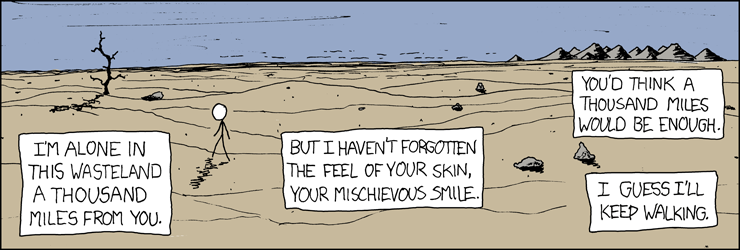
you make forgetting look so easy.


from xkcd.

east dillon.


I wrote about this once before, a long time ago. But I need to write about it again. There is no better television show currently on the air than Friday Night Lights. And chances are, you've either never heard of it, or you dismissed it because it's "about football."

It's not about football. It's about drama, relationships, family, high school, marriage, and small-town America, wrapped up in a football package. It's a double shot of life with a football chaser.

Friday Night Lights is filmed in an almost documentary style, all hand-held cameras and tight frame shots and unconventional angles, which combined with the superb acting leads to the feeling that these are real people, with real joys and sorrows, and we're all being granted a beautiful opportunity to share in everything. And Coach Eric Taylor, his wife Tami, and his daughter Julie are hands-down the most genuine family in television history.

It's like a reality TV show if reality TV didn't suck.


And this season (the show's fourth, which is currently airing exclusively on DirecTV but will come to NBC next year) may be the best of all, as it puts Coach Taylor in an impossible situation (reviving the dirt-poor crosstown high school's football team with a bunch of scrubs and no funding) and still manages to make his failures almost absurdly heroic.


(Also prominent in that scene: the Sufjan Stevens version of "Come Thou Fount Of Every Blessing," a perfect example of FNL's impeccable taste in soundtrack. Most incidental music in the series is provided by West Texas ambient-rock band Explosions In The Sky, a group I can't recommend highly enough.)

Look: if you like football, you need to watch this show. If you couldn't care less about football, you need to watch this show. (I privately suspect that more than a couple of girls I have dated enjoyed watching FNL with me more than they enjoyed, you know, me.)

If you are at all interested in good television, you need to watch this show.

I will buy you Season 1 myself if I have to.

Because I know you'll buy the rest on your own.